Some fabrics are stitched.
Some are printed.
Ajrak is breathed into existence.
Long before cameras, influencers, or fashion weeks, Ajrak lived in the dust of Sindh — carried by winds from Sukkur to Bhit Shah, worn on the shoulders of Sufi saints, malangs, and travellers who only carried two things with them:
Faith and a cloth that felt like home.
Ajrak was never “fashion.”
It was identity. It was grace. It was silence. It was music.
Today, as the world searches for meaning in the noise of trends, Ajrak returns — not as a product, but as a reminder. A reminder that beauty is slow. Art is patient. And culture survives only when someone loves it enough to give it voice again.
That voice today is Malang × Laal’9.
Where Ajrak Was Born — And What It Still Whispers
Ajrak begins in the hands of artisans who treat fabric the way Sufis treat poetry — with devotion.
Nothing about it is accidental.
Nothing rushed.
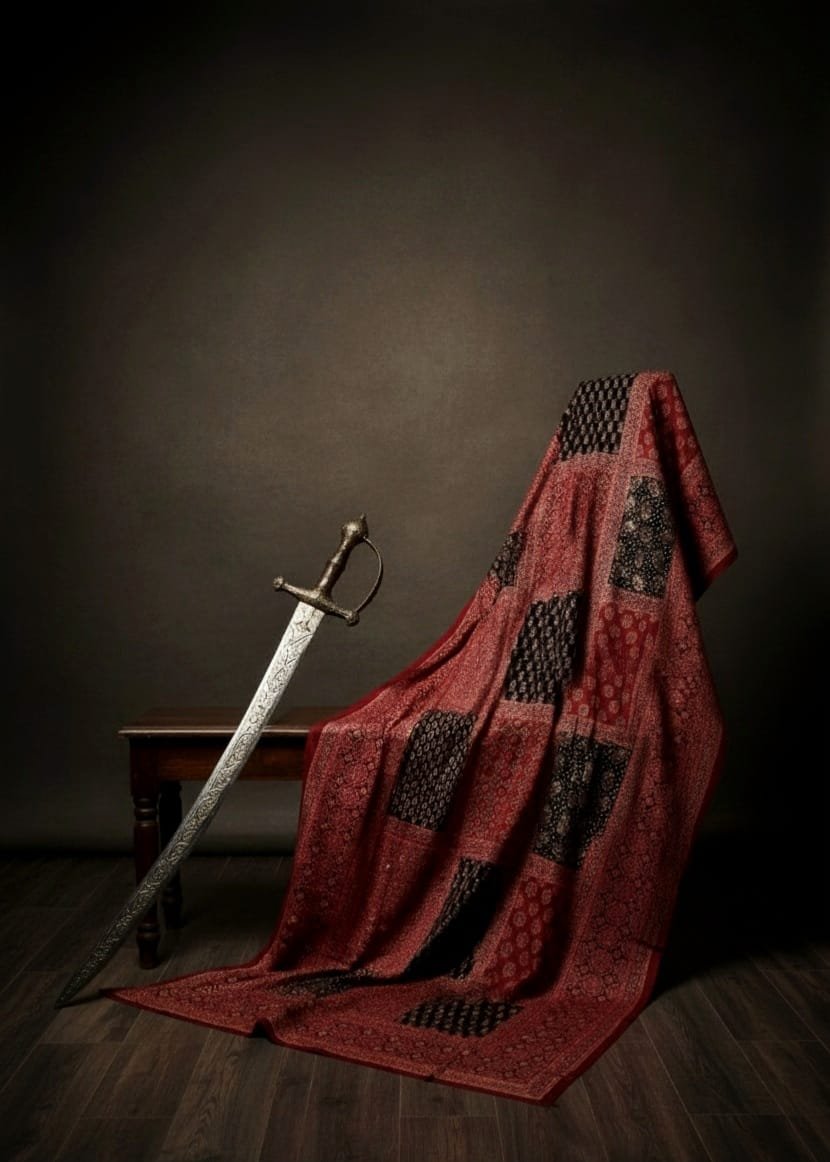
- The indigo: the blue of riverbeds
- The madder red: the shade of sunset on Sindhi sand
- The geometric blocks: symbols of the universe, repeated like chants
- The star motifs: the guiding lights for travellers of the desert
When a malang wraps an Ajrak around his shoulders, he isn’t wearing cloth.
He’s wearing history, prayer, sun, soil, water, and the breath of every artisan who touched it.
This is the spirit Malang × Laal’9 refuses to let die.
Where Heritage Meets 2025 — Without Losing Its Heart
Fashion in 2025 is obsessed with speed.
Ajrak is the opposite of speed —
and that is exactly why the world is coming back to it.
People today want meaning.
They want stories.
They want to feel something again.
And Ajrak is feeling woven into fabric.
On runways, in music videos, on Instagram reels, in global travel vlogs — Ajrak is resurfacing because it can stand alone without shouting.
It holds its own gravity.
But every revival needs a storyteller.
Every cultural piece needs a guardian.
This is where Malang × Laal’9 steps in — with music, with visuals, with the slow beauty of handcrafted shawls that look alive on camera, alive on skin, alive in silence.
The Malang × Laal’9 Essence — Fashion With a Pulse
Malang isn’t just a brand name.
It’s a state of being.
A certain surrender.
A certain freedom.
Laal’9 isn’t a channel.
It’s a window — into mood, into color, into rhythm.
Together, they create something rare: fashion with a pulse.
Ajrak on Malang × Laal’9 isn’t displayed.
It’s performed.
It’s felt.
It’s heard.
It’s seen the way music is seen — through emotion first, eyes second.
When Ajrak appears in a Laal’9 video, it becomes part of the soundscape — flowing with drums, breathing with vocals, catching light the way dunes catch the last hour of sun.
This is not e-commerce.
This is cultural rebirth.
How Ajrak Is Worn by the Soul
Forget “styling tips.”
Ajrak isn’t styled.
Ajrak is claimed.
Men wear it when they want presence without noise: - Draped over the back during winter evenings
- Laid across shoulders during music nights
- Folded neatly during travel as a companion
Women wear it when they want elegance without effort: - Over monochrome dresses
- As a loose shawl with open hair
- As a wrap during gatherings where warmth is more than temperature
Ajrak is not an accessory.
Ajrak is a statement:
“I know where I come from.”
Why Malang × Laal’9 Ajrak Is Different (Deep Truth, Not Marketing)
Because you don’t mass-produce culture.
You protect it.
Every piece curated under Malang × Laal’9 is slow-made, artisan-touched, sun-dried, and dyed with tradition — not shortcuts.
No factory can recreate that.
No modern print can imitate it.
No trend can replace it.